
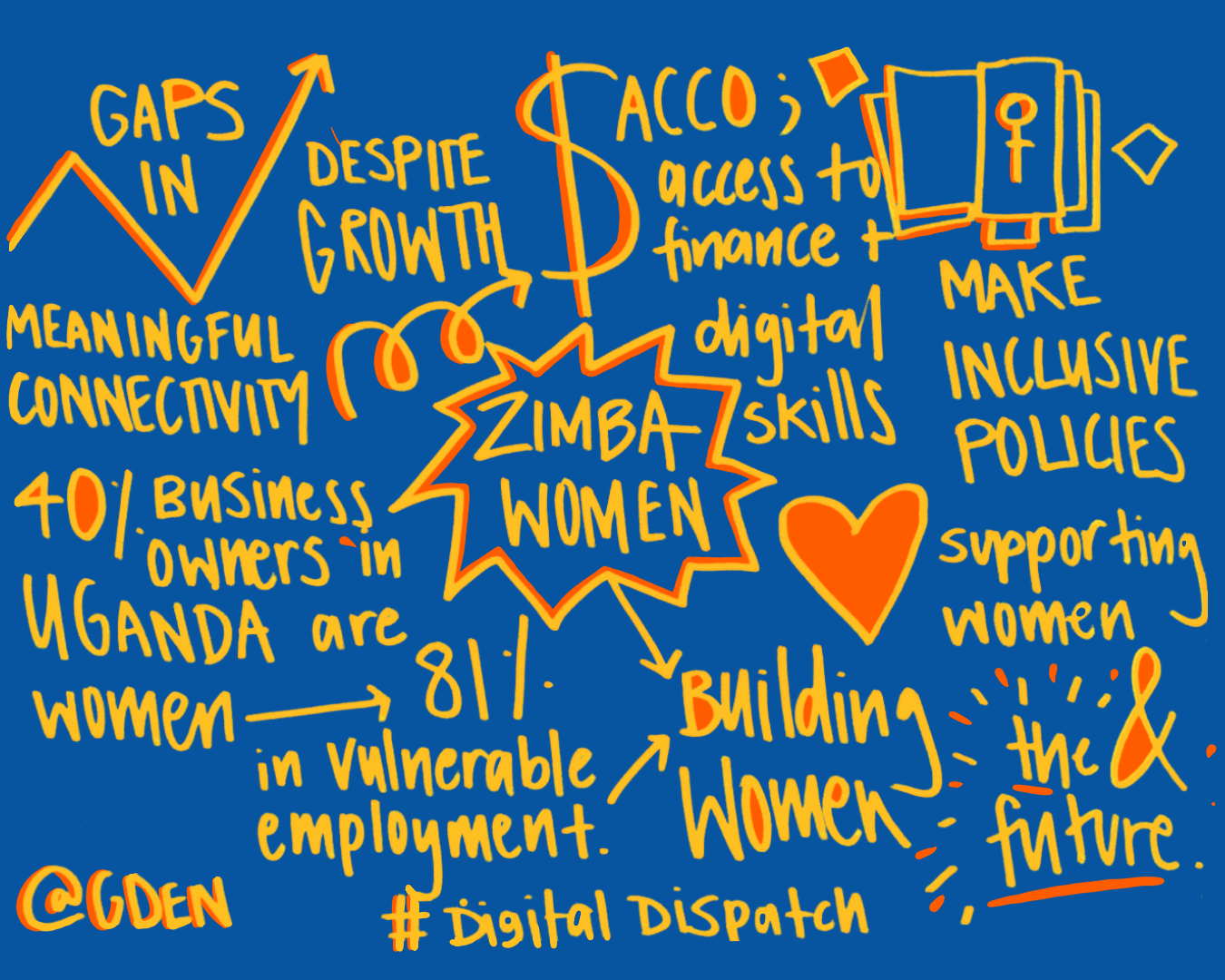
Synopsis: Conversation between Mark Tusiime, Zimba Women and Nikita Lakkaraju, GDEN on the opportunities and barriers shaping women’s participation in Uganda’s digital economy.
- To set the context: can we discuss the digital ecosystem in Uganda?
So, when I’m talking about Uganda’s digital ecosystem, it’s really an emerging ecosystem, and it is still growing, but still highly uneven. For instance, as of 2024, internet penetration stands at about 27% with roughly 13.3 million users, while mobile connectivity is much higher, at around 68% of the population. So you can see there is definitely quite a big difference, it’s not the same as meaningful internet access, right?
Many people can make calls and use different other services, with phones, like mobile money, but not necessarily participating fully in digital commerce and learning, given the fact that these need internet connectivity. So, when we zoom out to Africa, only about 38% of people use the internet, and for women, it drops to around 31%. Which highlights a gender digital divide, yeah.
So we are seeing growth in connectivity, but the real gap is, within meaningful usage, and most especially for women.
- Can we discuss the economy in Uganda/ sub-Saharan Africa– compared to other regions of the world, sub-Saharan Africa has the highest number of female entrepreneurs– who are they/ what needs do their businesses serve?
Yes, so when you look at sub-Saharan Africa, it really stands out from the global scale, because of the number of women who are engaged in entrepreneurship. As you have mentioned, generally Sub-Saharan Africa has quite a large number of women entrepreneurs. And, in fact about 40% of women make up the percentage of business owners in Uganda alone, which is one of the highest rates globally. So you’ll find in other regions, it’s way lower as compared to Uganda.
However, most of these businesses are informal, they’re small-scale, and they are more survival-driven. When I say survivor-driven, I mean that it’s just a matter of how these women can get money and put it into their pockets, just to take care of their families, their households, and all that. Additionally, over 81% of the women are in vulnerable employment: I’m talking about low income, low security, and limited growth potential. So, we do not have a participation problem, because, as we can see, there is a very big number, or when it comes to women in the space, but rather a quality and scale problem. Hence the quality of entrepreneurship that is being offered, by these women, and also the level at which these businesses are able to scale is still quite low.
- What kind of educational opportunities/ systems/ government initiatives already exist for women who wish to start their own businesses/ learn about trade & commerce, how are they accessed?
So, when you’re speaking about the government, it’s a bit, all over the place. Because you find that even in the policies that are currently in place, we still have a gap when it comes to gender inclusion. But different initiatives have been put in place to see to it that there is inclusion of women within different learning schemes. I’ll give an example of one program that we’re implementing with, Uganda Communications Commission.
This is something, where we are scaling, women across the country, and for over the past 3 years as Zimba Women, and, this is our third phase of, implementation. We are skilling women in basic digital skills and trying to see how best they can use them to grow their businesses and also support them in different initiatives.
Are current digital platforms and tools designed with women users in mind?
There’s some emerging digital technologies, but of course, going back to the whole point of the connectivity issue, you find that there is still a very big gap when it comes to connectivity, so the individuals are there, the platforms are there. But, the problem is that women do not have access to connectivity.
- Let’s go further into the kind of systemic barriers that women are facing in this context. Firstly, when it comes to using digital tools and digital platforms, and also, when it comes to their own businesses and their entrepreneurship. What does it mean for women and girls to be meaningfully connected in the Ugandan context?
One of the biggest systemic barriers that we have is that women entrepreneurs are facing overlapping barriers. So, here you have limited access to finance, digital exclusion, culture constraints, which are a very big factor. For example, about 45% of women entrepreneurs in countries like Uganda, do not have regular internet access due to the cost. It’s a very high cost, and we were recently doing an evaluation of how much the internet is being charged for in Uganda versus other countries, and it is really, really high.
57% of women report experiencing online harassment when doing business online, so that is also a very big factor. And even more locally, when you bring it down to the Ugandan context, nearly half of the women report experiencing online harassment. This is something that has happened most of the time, so access is one issue, but when you look at other things that are constraining these women, you look at safety, affordability, which are equally critical, and are one of the biggest systemic barriers that are hindering, access to some of these, platforms.
- What are the origins of Zimba Women? Where did the idea come from?
What is the impact Zimba Women has seen since its inception?
Okay, so Zimba Women, as the name says it, stems from one of the local languages in Uganda, that is, and Zimba means build. So, it is literally saying, “build women”.
Zimba Women was started by two phenomenal women, who had the vision to create an inclusive ecosystem where women can participate meaningfully and also gain access to various resources. It has been in existence since 2015. We have worked on various programs with different partners, for example, Facebook, USAID, the Mastercard Foundation, and other partners across the globe.
Through all these different initiatives that we are working on with the different partners, we have impacted over 80,000 women across the country– now those are just women that we have been able to directly reach, but there are others that we have been able to reach indirectly, through a ripple effect, through different messaging across our different platforms.
Currently, we are supporting women in three different areas. One is access to finance, where we are availing women entrepreneurs with access to affordable digital finance, through a revolving fund.
Then the second one is through digital scaling, which is in partnership with Uganda Communications Commission. And, with this, we are looking at over 25 districts, just this year. Last year, we were able to look at tackling 25 districts. The previous year, we did work in 7 districts. So, if you had to look at the whole number, it’s about 57 districts. In each district, we’re looking at about 200-plus women that we are impacting meaningfully, and who are gaining the skills that are needed.
We have worked with different partners, and we are still growing with a dream to create,
a movement, or create an environment where women have access to meaningful access to various resources, be it the digital space, be it access to finance and other resources.
- This brings me to another follow-up question about the work of Zimba women. When we talk about digital skilling, we’re talking about training, we’re talking about the work on the ground that this organization is doing with women. How does Zimba Women integrate with the existing system’s features, or can you tell me a little bit more in detail the kind of digital literacy training or skilling you provide?
The digital skilling that we do provide is very targeted. We do train women in different skills that they need. We don’t want to do just an ad hoc training and then leave it at that. Because at the end of the day, if we give them the skills, they won’t be in position to use them. So, we try to, as much as possible, get into a scenario where we get to understand what their needs are. After understanding what their needs are, then we train them in that.
You’ll find that there is, it’s, it’s really at very large scope. There’s digital finance, there’s digital entrepreneurship, then basic digital skills, like Microsoft Word and all the different applications, mobile money, which is highly used in Uganda, digital banking and all that.
So, it’s really, really targeted training that we offer to the different beneficiaries.
- Can we discuss the impact of Covid-19/ the impact of everything from e-commerce to entertainment and education, governance and health services moving online?
How did Zimba Women navigate this time with its entrepreneurs?
Zimba Women is built, really, on the backbone of technology and the digital space. So, with COVID-19– yes, it really did hit us hard. But at some point, we really just had to adapt to the situation and see how best we can move from the physical training, and have more online training.
I want to say that the first year, which was 2020, really hit us hard, because lockdown was in effect, most of the women were still facing connectivity issues, they did not know how to use their smartphones, and most of the things around that. It was very hard, and it put a halt to some of the work that we were doing, but we were able to reach out to a few other women that were still online.
Along the way, we were able to convince different other women that were not online, and still grew the movement, and were able to have more women join us on the online trainings and, initiatives that we were having, and, trying to see how best we can also look at a hybrid kind of setting, where we have some physical, we have some online, so that some of these women will now pick up the pace and, get to understand and appreciate, the movement from, having only physical engagements to online engagement.
So, COVID-19 really did hit us hard, as it did everyone, and most especially on the side of the beneficiaries that we work with. But, as the years have passed, we have really worked so hard to situate that more women can now jump on to the bandwagon and get to enjoy some of these benefits.
- What policy level changes in your opinion are most urgently needed to support women in the digital economy?
In policy, I would say we need to be highly intentional with inclusive policy making. And not just, ad-hoc policymaking. So I usually joke that when you talk about inclusivity in policymaking, people just get the color pink and paint it on the policy paper, because it’s a ‘feminine color’, and say, “you know what, we have included the women, we have included the youth, we have done all that.”
But it is a whole different scenario. It is a whole different engagement. When you’re inclusive, when you’re intentional about the whole point of inclusivity, when you’re intentional about getting women access to the digital economy. We’ll start small. It’s not that we’re just going to wake up and most of the policies are going to change, and things of that sort, but we’ll start small and start from somewhere.
At least what I can say is some of the policies in Uganda now, like the Computer Misuse Act, does hint a bit on the gender perspective, but not entirely. So there’s still some gaps that look at it. When you look at access to digital infrastructure, there is a bit of a gap.
I would now want to link policies, to practices, and standards. So, still, the policies might be lacking. But there are at least initiatives that have been put in place movements that are moving towards the whole ideology of inclusivity within these policies. And, of course, the policies highly influence the practices, which in turn influence the standards that we do have when it comes to access to infrastructure.
There are definitely deliberate initiatives that are being put into place, but I believe we can do more with our movements.
How has participation in Zimba Women’s programs changed women’s decision-making power at home or in their communities?
One key thing is, however much we are trying to work and support the women, we cannot leave out the whole structural barrier or the cultural barrier that we have in place, around men dominating the space, and also the fact that we– Uganda is a very deeply cultural country.
And when I say that, you’ll find that women– whenever we have training sessions– need to get permission from their spouses to attend these engagements. So, one deliberate move that we did is involve the men as well. Involve them, so that they can appreciate the value of what the women are going to get. Because at the end of the day, once the woman has been trained and has gotten the experience, she is still going to come and have to be able to use the tools to feed her family. She’s going to be able to use skills that she has gained to support the husband, and also build a community. So, one deliberate move that we usually do is involving the men in every step.
- Tell us a bit more about SACCO (credit union) and any notable examples that have emerged from this?
Zimba Women is built on pillars of access to different resources, and access to finance is one of them. We thought it right that we need to build a culture of serving with the women, within the women. That is when we came up with the whole idea of a circle, where the women keep saving on a monthly basis, but when they save, they’re able to get access to different financial resources, like loans at very low interest rates. Also, if we’re able to get a partner on board that is willing to give grants, we do give grants to most of the women within the circle.
We have been running this for the past 2 years, and we have over 100 women so far that have joined the circle and are actively saving within the circle, and they are able to access different finance, and other resources, like skills, and technical capacity to support their businesses.
At the same time, the circle has also been able to attract different funders for us. I’ll give an example. We are currently working with an organization called Nemani Microcredit, based in Italy. And they are funding a revolving fund that we are managing as Zimba Women under the SACCO. And the idea here is to give access to finance to different women so that they can run their businesses and similar activities.
- What is Zimba Women looking for in the world?
We are looking at a world where women are leading in entrepreneurship. And the opportunity now is ensuring that they have the digital tools, financing, and ecosystem support to scale some of their solutions. The data clearly shows where these gaps are. It’s just a matter of us understanding how to use this data, and build different solutions that would support the women.
We’re looking for a very inclusive world where women are able to easily access different resources, digital resources, financial resources, technical resources, and skills, without having to go through so many hurdles, the different social, cultural and other barriers.