
Synopsis: Conversation between Patricia Namakula, CfMA and Abner Manzar, GDEN on Uganda’s digital divide shaped by affordability, infrastructure, gender, geography and cultural barriers.
- To set the context: what is the situation of digital divide in Uganda and what does it mean for CfMA’s work?
So, when it comes to the environment, or the issue of the divide in Uganda, we realize that the gap is still significant. With access to the internet at 28%- that means that over 70% of Ugandans remain offline. And this divide is multilateral. It manifests in different forms. There is gender, where women and girls lag behind as compared to men. And it’s urban, rural– where? The infrastructure is mainly concentrated in cities and urban centers. As well as access to electricity, so you find that people– rural citizens are kind of excluded in that format. But also, it manifests itself in terms of affordability. Who can afford data? Who can afford the devices? You find that, and because of the poverty levels that are high in Uganda. Many people cannot afford, especially women, and the older populations.
- What are the systemic barriers to digital inclusion/ widespread digital literacy?
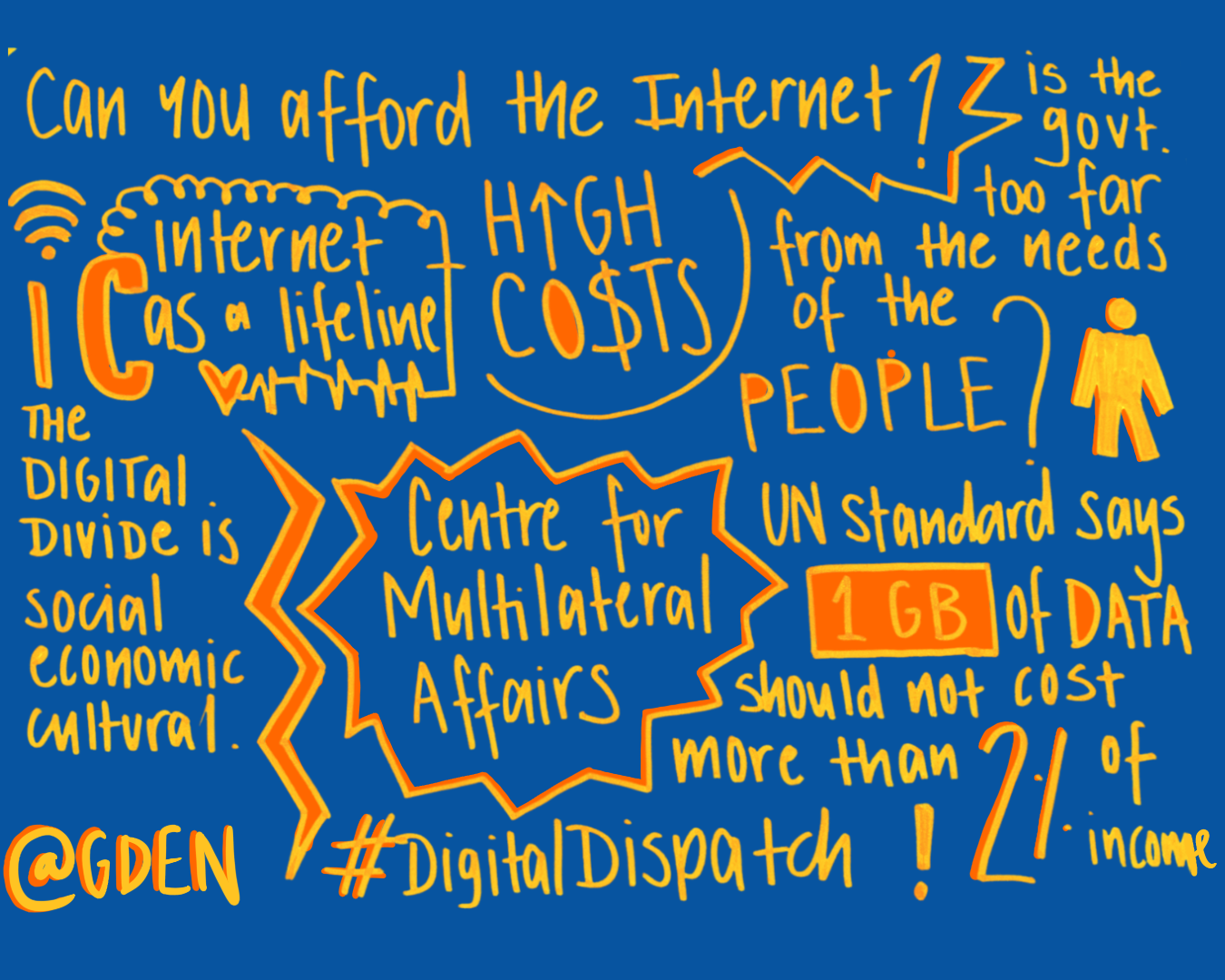
When it comes to the barriers to access to the internet and use, they are structural in nature, I talked about affordability, as a hindrance. Because, the UN standard says that 1GB of data should not cost a person more than 2% of their income, but then that remains high, based on how much people earn here in Uganda, especially those in the informal sector.
The divide is mainly in the form of affordability– like women, the youth that are mainly unemployed– in Uganda, most of the young people have no jobs. So the youth and then the older generation, because there are no retirement benefits, so those groups of people are not able to afford the devices, or even, the data.
But then also, the divide manifests itself in the rural and urban. When you look at Uganda, rural broadband penetration is below 30%. Meaning that well over 60% of rural dwellers cannot access the internet, because there’s no broadband. Which means they can’t use smartphones, they can’t use the internet generally. Yet, we should appreciate that the UN has declared the internet as a basic need.
It’s a right, people need it for accessing education, health services, information, but if we see that this significant number of people or population can’t afford it, because of where they are located geographically, then that’s just one reason that they are offline.
The divide can also be social, cultural, and economical. For people who are poor, they cannot buy these devices because of the costs, but also because of some cultural practices. We have communities here where a woman can’t own a phone. Because of the primitive nature of these cultures or structures which can promote or support the divide here in Uganda and elsewhere.
- What are the existing community-based solutions that have emerged organically to overcome these barriers? How effective are they and what are the limitations?
Some of the community-led solutions are community IT hubs and libraries, in rural areas. And this, usually, the populace can access the internet, through a shared MiFi or Wi-Fi device. Another is the Pay As You Go Initiative by MKOPA here in Uganda, where they are giving out accessible smartphones and solar-powered tablets to rural households, so that they can access the internet. And we have civil society-led and private sector-led training and initiatives where they go out to build, like, digital skilling for women and girls, for groups that are usually excluded, like persons with disabilities, or refugees.
As for whether they are effective? It’s a yes and no answer. They are effective in a way that they build the foundational skills of the beneficiaries. For example, women have those basic skills of how to use a smartphone– especially those that are in the business community, they kind of get a breakthrough into the digital economy, so they know how to, build a website, or use AI for different things. So these solutions are helpful in some ways. But they are not sustainable.
This is because most times they are small-scale and limited in terms of reach, but then also they’re donor-funded, so there’s no sustainability. Most importantly, they cannot address the structural issues, like cost and infrastructure– because that takes government policy-making to address.
- (Follow up question) A lot of times, we see that the government policies are sometimes not what the people need, because the government is too far from the needs of the people. But in Uganda’s case, how well do you think the government has been able to understand the needs of the people– even if it is through organizations– and are they really building policies that can help in bridging this kind of divide?
I think the government has realized the need for making evidence-based policies, putting work into the needs of the population. But then, we need to appreciate the fact that our government is limited. So they are making efforts to ensure that the policies they make are in line with the needs of the people, because then there won’t be uptake. People won’t see value in these policies, but that’s still on the low side. So, we (the CfMA) work closely with the government, that is the Ministry of ICT, and provide national guidance. As we produce these evidence-based, policy briefs, and present copies to the Ministry in hope that they read the research and do better, in policy-making. So that they can actually make policies that address the needs of the people– Policies that are inclusive, policies that are gender-sensitive, but also policies that are in line with what’s on the ground, or the needs of the population.
- What are the origins of the CfMA? Where did the idea come from? What is the impact the CfMA has seen since its inception?
The Centre for Multilateral Affairs was founded in 2019, following a peer-reviewed submission at a multi-stakeholder convention– the Internet Governance Forum, that was in Addis Ababa that year. A colleague submitted a peer review and presentation at that conference. Moses Owiny (founder) had observed the fact that Africa’s and the wider Global South perspectives are not well represented at such stakeholder forums. Like, our voices, especially when it comes to norm-forming or making policies, are not well represented, so that birthed the Centre for Multilateral Affairs. We work to bridge that gap: through informed research, through advocacy for inclusive multilateral policy making, so that Africa is represented, the Global South is represented. When you look at the UN, you’ll find that most of their work is in the Global South– which means that we ought to be at the table where the policies are formed.
And so, if we can bridge that gap through the work we do, through the information that is evidence-based that we share and put out there, through the webinars that we hold as the center, through the partnerships that we hold with like-minded organizations like yourself; then we would know that we’ve added a block or a brick to ensuring that, there’s inclusive policy making.
- Can we discuss the Centre’s work on increasing the participation of Global South groups? How does the CfMA align itself with existing or other multistakeholder and multi-lateral groups/ organisations (UN, EAC, etc)?
We really do acknowledge that no organization can work alone. To advocate for inclusive policymaking, especially around addictive technologies, we work hand-in-hand with, like I mentioned, like-minded organizations like yours. We work closely with Women of Uganda Network (WOUGNET), we work with CPESA,we recently became members of APC which is such a wide community of organizations in the Global South that are working to bridge the digital divide.
How we work is either we partner for webinars, for workshops, for digital skilling of the groups that we serve. We attend conferences and make presentations, or host sessions at large stakeholder forums. So that’s how we work, to ensure that we are not alone, but are working in partnership with not only the other civil society organizations, but the government, and UN entities that work in this space, to close the gap. We have produced reports– for instance last year, we made a report on AI governance in Uganda, and the objective of that report was to ensure that the government proposes AI policies, that they are inclusive and gender-sensitive.
The groups that we are looking at here are underserved and excluded, we keep them in mind as they’re making these policies.
Through research, we produce reports, and out of the reports, we break it down to policy briefs that can be easily digested by policy makers. We also share the work we’ve done in wider communities so that it can have a wider impact.
- Let’s discuss cyber-security in the African digital ecosystem and the need for safe data practices– how are communities or organisations in this space building digital resilience, or ensuring that their data is safe and not exploited?
I was looking at 2025 reports focused on fraud instances in Africa. And the findings were insane, like just how much people lose, and how much they are defrauded online. When we talk about cybersecurity from the African perspective, the policies are definitely fragmented.
There’s not a free flow of information in terms of regulation on the continent or in East Africa, to be specific. So Africa faces fragmentation in data protection, in cybersecurity, e-commerce, and around that area. Although, there are frameworks in place across the continent to ensure that there’s alignment in policy, just like we see the African Free Continental Trade Area– there are some initiatives trying to replicate these in the digital space. But I strongly believe it will take a while for them to catch up.
We advocate for multilateral and bilateral frameworks, to harmonize cross-border data flows, to coordinate cybersecurity policies across the continent, but also to enable, continental digital markets. Many ICT companies, or the biggest IT and tech firms, are not in Africa– they’re in the United States. I’ll give you an example: Facebook has no office in Uganda. So if you have an issue with Facebook, you have no help. These are gaps that players like the CfMA, like GDEN, can work on in the Global South– we can collaborate to ensure that Facebook can be held accountable, in case of a data breach. Because they’re making money off of our data. They are building, and we are the consumers or users of these technologies.
So, there is a need to ensure that civil society, the private sector, which builds the technologies, and the government, which makes these policies– are able to be held accountable when citizens’ data is misused. When, for instance, women are abused or face violence online, there should be a coordinated effort by the builders of these technologies, and by policy makers to hold the builders accountable, that their technologies are right-respecting, that they are gender-sensitive, that they are inclusive, they cater to persons with disabilities, they cater for different languages and so on,
As for civil society, our work is definitely to advocate– not only to advocate, but also to produce evidence-based research that can inform policy, be advisory to the technologists, or to the people who make the technologies.
- What is the Centre for Multilateral Affairs looking for in the world?
The Centre for Multilateral Affairs, is a think-tank. We envision a world where the internet is affordable, inclusive, that offers opportunities for all groups of people. We hope to build deeper partnerships with different players across the board.
We hope to continue with the work that we do, research, the scaling, and we hope that the government and the folks who own the technologies, that they’ll actually notice the fact that technology, the internet is a basic need.
People use it for various purposes, access to health services– I think that’s what the pandemic showed us. It actually exposed the gaps between those who are online and those who are offline, but also post-pandemic, governments have appreciated the role of the internet, and particularly in Uganda, we’ve seen the government move most of its services online.
Like, passports, IDs, most of its services, they moved online, that was all an awakening post the pandemic, and we’re not sure that there won’t be another pandemic, right?
So it’s high time that all stakeholders appreciate the role of the internet, not only as an enabler, but as a lifeline for different groups of people in society. And for us, as the Centre for Multilateral Affairs, we will continue working with other players, be it civil society, be it government, be it development partners. Be it the private sector, to ensure that the internet, that data, the devices are accessible, are affordable, but also that the policies themselves are inclusive and gender sensitive.
Join the community of the different actors in the Global South that are working to break the digital divide.